
Collect. Annotate. Validate. Build Better AI

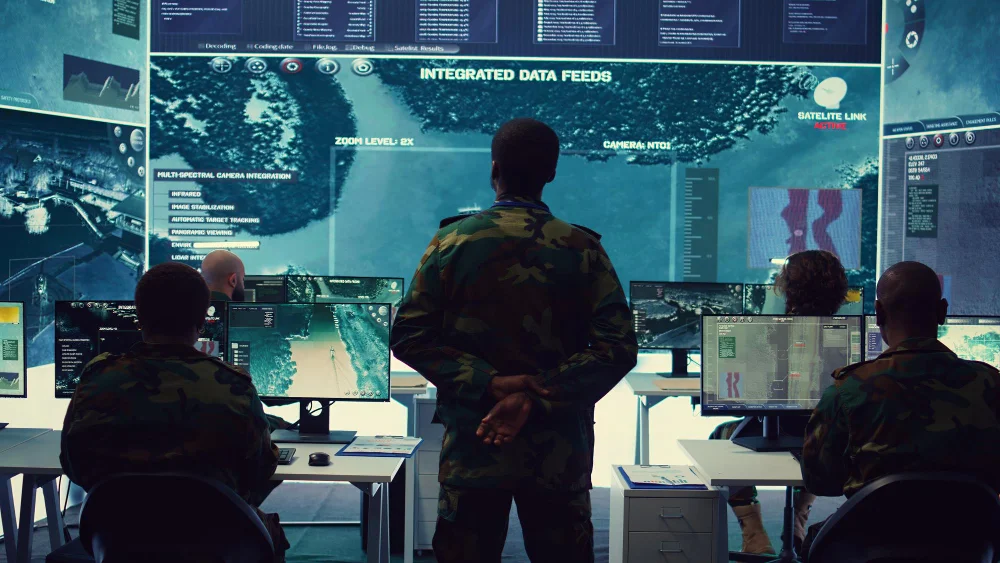
Surveillance and Security Data Annotation for Threat Detection Tracking AI

Security models fail in low light, crowds, and small distant targets. We annotate CCTV, thermal, drone, and satellite data in a secure facility through a multi-stage QA process, so your model trains on labels it can trust.

  • 13+Years of annotation expertise
  • 20+Industries served
  • 97%+Quality benchmark
  • 24x7x365Secure operations
Introduction

Defense, Security & Surveillance AI Data Services: Reliable Data Collection, Annotation & QA

The standard we hold
The accuracy of your labels is the accuracy of your AI model, and our process is built around that.
  1. 01The challenge

    Security footage is rarely clean. Targets are small, crowds overlap, night and thermal images lose detail, and drone views shift in scale. Rare events such as weapons or abandoned objects appear in very few frames, so each one must be labeled correctly.

  2. 02The impact

    Labeling errors become missed threats, false alarms, and operators who stop trusting the system.

  3. 03Our approach

    Annotators are trained on your threat classes and escalation rules before production begins. The work is done in a secure facility with biometric access, 24x7 CCTV monitoring, guards, and a ban on cameras and unauthorized storage devices, under strict confidentiality agreements. Every batch passes internal and external quality checks.

Capabilities

Defense & Security Annotation Services

  • Crowd Surveillance and Crowd Density Analysis

    Crowd models must read busy scenes where people overlap and move in different directions. Our video annotation services label individuals, groups, and density levels in stadiums, stations, malls, and public spaces, using bounding boxes, point markers, and density tags. Annotators follow your counting and occlusion rules, so models learn to estimate crowd size and movement reliably.


  • Weapon and Threat Detection

    Threat detection models need clear examples of weapons in varied conditions. We annotate firearms, knives, blunt objects, and other items you define, using bounding box annotation and polygons on images and video. Annotators label objects that are partly hidden, held at different angles, or captured at long range, so models are trained on realistic scenes and not only on clean samples.

  • Facial Recognition and Face Detection

    Face detection locates every face in an image, and recognition models learn to tell them apart. We place bounding boxes around faces and add landmark annotation and key point annotation on features such as the eyes, nose, mouth, and jawline. Consistent landmark schemas help models handle different angles, lighting, expressions, and partial coverage.

  • Person Detection and Tracking

    Person detection models need to find individuals reliably in crowded and cluttered scenes. We draw bounding boxes around each person and follow them across frames with persistent IDs, correcting identity when people overlap, leave the view or return. This human-annotated data trains models that count people, follow movement, and support video analytics in computer vision.

  • Vehicle Detection and Tracking

    Vehicle models must recognize cars, trucks, buses, two-wheelers, and other road users across fixed and moving cameras. Annotators label each vehicle by class, track it from entry to exit, and maintain its identity through occlusion. These labels support traffic monitoring, perimeter control, and incident review.

  • Suspicious Activity Detection

    Suspicious activity models learn from footage where unusual behavior is clearly tagged. We annotate actions and sequences that you define as suspicious, such as unusual movement, interaction with restricted objects, or deviations from normal patterns, and label each event with start and end times. Clear definitions and review checks keep tags consistent, so models learn from dependable examples.

  • Theft and Intrusion Detection

    Theft and intrusion models rely on labeled footage of forced entry, unauthorized access, and removal of property. We annotate people, objects, and actions across the sequence, tagging each stage of the event. This helps models recognize the behavior early enough for security teams to respond.

  • Prohibited Item Detection

    Prohibited item models must recognize restricted objects in bags, on people, and in scenes. We label items from your restricted list using bounding boxes and polygons, including items that are partly obscured or packed among others. Annotators follow clear class definitions, which reduces missed detections and false alarms at screening points.

  • Security Checkpoint Annotation

    Checkpoint footage and scans need careful labeling of people, belongings, and screening equipment. We annotate individuals, bags, items on conveyors and screening stations, and tag events such as bag placement, removal, and secondary checks. These labels support models that speed up screening while keeping procedures consistent.

  • Night Vision Image Annotation

    Night vision images are low in color and contrast, which makes labeling difficult. Our image annotation services cover people, vehicles, animals, and objects in low-light and near-infrared captures, with annotators trained on how subjects appear in these conditions. Accurate labels help models perform when daylight cameras cannot.

  • Thermal and Infrared Image Annotation

    Thermal images show heat signatures, so objects look different from visible-light photos. We annotate people, vehicles, animals, and equipment in thermal and infrared footage, and tag heat-related features where your project needs them. This supports detection in darkness, smoke, fog, and glare.

  • Drone and Aerial Surveillance Annotation (Detection and Tracking)

    Drone footage presents small objects, changing altitude, and moving cameras. We annotate people, vehicles, structures, and activities in aerial images and video, and track them across frames with consistent IDs. Annotators handle varied scale and angle, so models perform well in border, perimeter, and large-area monitoring.

  • Access Control and Security Monitoring

    Access control models need to know who and what enters controlled areas. We annotate people, badges, doors, gates, vehicles, and entry events, and tag authorized and unauthorized access according to your rules. These labels help models support entry logging, tailgating detection, and real-time monitoring.

  • Abandoned Object and Unattended Baggage Detection

    Abandoned object models must distinguish unattended items from those a person is still using. We label bags, packages, and objects, link them to nearby people, and tag when they are left behind. Time-based labeling gives models the context they need to raise alerts in stations, airports, and public venues.

  • License Plate Detection and Recognition

    Plate detection locates the plate on each vehicle, and recognition reads its characters. We draw bounding boxes around plates and, where your project requires it, transcribe the characters. Annotators work with angled, blurred, dirty, and partly covered plates, following defined guidelines for each case.

  • Human Activity and Action Recognition

    Action recognition models learn what people are doing, not just where they are. We tag activities such as walking, running, falling, fighting, carrying objects, and entering or leaving areas, with start and end times on video. Consistent action definitions help models separate similar movements and reduce confusion between classes.

  • Loitering and Restricted Area Detection

    Loitering models flag people who stay in one place too long, and restricted area models flag entry into zones that are off-limits. We label people, defined zones, and dwell durations, and tag each breach with its time and duration. Clear zone boundaries and timing rules keep labels precise and repeatable.

  • Fire, Smoke and Hazard Detection

    Hazard models must recognize danger early, often when the signs are small. We annotate flames, smoke, sparks, spills, gas clouds, and other hazards in images and video using polygons and segmentation masks. Careful labeling of faint and spreading smoke helps models detect incidents before they escalate.

  • PPE and Safety Compliance Detection

    Compliance models check whether people are protected for the task and area. We label helmets, vests, gloves, glasses, masks, and harnesses, and tag each person as compliant or non-compliant under your site rules. Consistent labeling across distances and angles helps models flag real breaches and limit false alerts.

  • Security Camera Video Annotation

    Security cameras produce continuous footage across many views and conditions. Our video annotation services label people, vehicles, objects, and events across fixed and multi-camera setups, with timestamps and persistent IDs. The output is human-annotated data that models can use for detection, tracking, and incident review.

  • Object Detection and Multi-Object Tracking

    Object detection annotation finds each item of interest in a frame, and multi-object tracking follows every item across time. We label classes you define, keep identities consistent through occlusion and crossings, and review tracks for drift. This combination supports surveillance models that count, follow, and analyze many objects at once.

  • Scene and Terrain Understanding

    Scene and terrain models need to understand the environment around the camera or sensor. We apply semantic segmentation services to separate ground, roads, buildings, vegetation, water, sky, and obstacles, and label terrain types according to your schema. These pixel-level labels support navigation, route planning, and situational awareness.

  • Military Vehicle and Equipment Detection

    Defense models need to identify vehicles and equipment from ground, aerial, and satellite views. We annotate vehicle types, weapons platforms, support equipment, and related infrastructure using bounding boxes and polygons, following class lists supplied by your team. Work is carried out under strict confidentiality in secure, access-controlled delivery environments.

  • Aircraft and Vessel Detection

    Aircraft and vessel models must recognize craft at varied scales, distances, and angles. We label aircraft, ships, boats, and related features in aerial, satellite, and camera imagery, classifying each by type according to your taxonomy. Consistent labels help models support airspace, port, and maritime monitoring.

  • Satellite and Geospatial Image Annotation

    Satellite imagery covers vast areas where objects appear small. We annotate buildings, roads, vehicles, aircraft, vessels, land cover, and other features using polygons, boxes, and segmentation masks. Annotators follow your resolution and class rules, so geospatial models learn consistent patterns across scenes.

  • Content Moderation and Offensive Content Detection

    Moderation models need clear labels for content that breaks policy. We review images, video, and text and classify material such as violence, explicit content, hate symbols, and prohibited items according to your guidelines. Annotators work to defined escalation and review steps, so decisions remain consistent and auditable.

Our Toolkit

Data Annotation Capabilities

  • 3D Point Cloud Annotation & Segmentation
  • Semantic, Instance, and Panoptic Segmentation
  • 2D and 3D Bounding Boxes
  • Keypoint Annotation
  • Landmark Annotation
  • Polygon Annotation
  • Polyline Annotation
  • Image Classification & Tagging
  • Video Tracking & Tagging
  • Question and Answer
  • OCR
  • Image formatsJPEG, PNG, TIFF, BMP, EXR, RAW, GeoTIFF, JP2
  • Video formatsMP4, AVI, MOV, MKV
  • Point cloud / 3DPCD, PLY, LAS, LAZ
  • Medical formatsDICOM, NIfTI, EDF, BDF, WFDB
  • Geospatial / Remote sensingGeoTIFF, NITF, CEOS, SAFE, ENVI, NetCDF
  • Robotics / MiddlewareROS Bag, MCAP
  • Structured dataCSV, JSON, JSONL, XML, TXT, Parquet
  • Audio formatsWAV, FLAC, MP3, AAC
  • AutomotiveDBC, ASC, BLF, MDF
  • Scientific / BinaryHDF5, MAT, TDMS, BIN
  • SonarXTF, JSF, S7K
  • Motion CaptureC3D, BVH, FBX
  • MicroscopyCZI, NDPI, SVS
  • NavigationNMEA, GPX
  • Messaging / StreamingMQTT
  • NeuromorphicAEDAT
  • EEGSET

Need training data collected for your industry?

Explore our data collection services.

Explore Data Collection
Best Practices

Why Leading AI Teams Choose Qualitas Global.

  1. Speed and Accuracy

    Domain-trained expert annotators and daily throughput tracking against SLA targets.

  2. Trustworthy Output

    A rigorous multi-level quality assurance process that ensures a 97%+ quality benchmark, validated on every project.

  3. Rapid Scale-Up

    A risk-free 2-day pilot before full production, and team deployment within 24 business hours of sign-off. You see our work before you commit to volume.

  4. Customised Workflow

    Every engagement is tailored to your goals, with annotation guidelines, QA, and delivery cadence adapted to your project.

  5. Lower Total Cost

    Pay-per-verified-productive-hour billing. You are not paying for our learning curve or mistakes, our internal rework, or idle bench time.

  6. Data Security

    ISO/IEC 27001:2022, ISO 9001:2015, TISAX Level 3, HIPAA, and GDPR compliance. Biometric access, 24*7 CCTV monitoring, and policies and procedures that prohibit cameras and unauthorised storage devices on the floor.

SECURITY & COMPLIANCE

Certified to Handle Your
Most Sensitive Data

100% in-house delivery. No outsourcing, no work-from-home access to client data, no exceptions.

ISO/IEC 27001:2022
ISO/IEC 27001:2022
ISO 9001:2015
ISO 9001:2015
TISAX Level 3
TISAX Level 3
ISO/IEC 30107-1:2016
GDPR
GDPR
HIPAA
HIPAA
Got Questions?

FAQs

Still curious?Ask our team directly
  • Surveillance video annotation is the structured labeling of data so a machine-learning or analytics system can learn from examples or be evaluated against defined criteria. For defense, security & surveillance, the work begins with a written label taxonomy, clear inclusion and exclusion rules, and representative sample data. The exact scope depends on the model objective and the client's acceptance criteria.

  • Depending on the approved scope, defense, security & surveillance projects may involve objects, people, vehicles, activities, scene changes, and other visual events explicitly defined in an approved annotation policy. The team should define each label, the unit being annotated, how to treat uncertain cases, and whether the task is frame-level, object-level, document-level, or text-level. These examples describe possible project requirements, not a guarantee that every modality or use case is currently offered.

  • Output formats and tooling should be confirmed during discovery rather than assumed from a general industry page. The project brief should specify the required schema, field names, class IDs, metadata, export structure, and any client platform access. Qualitas Global should confirm compatibility with the requested tools before the pilot begins; no specific format or third-party platform is promised here.

  • A quality plan should define the annotation guideline, reviewer responsibilities, sampling or review coverage, error categories, escalation rules, and acceptance criteria before production. Multi-level quality checks are a stated part of the intended service approach, but the exact workflow and quality SLA need internal confirmation. Disagreements should be documented, corrected, and reflected in updated guidance where the same issue could recur.

  • Data access, storage, transfer, retention, deletion, and physical work arrangements should be agreed before any sensitive files are shared. The project owner should confirm the applicable security controls and whether any certification or regulatory commitment applies to the specific engagement. Do not assume a particular ISO standard, HIPAA status, GDPR status, or other certification without current internal evidence.

  • Pricing should be scoped around the task definition, data complexity, annotation guideline, expected review effort, language or domain requirements, and the delivery arrangement. The stated commercial model is based on productive hours, with scope and acceptance criteria agreed in advance. A quote should clarify what counts as productive work, how rework is treated, and which activities are included, without relying on an unverified public price.

  • Yes, the recommended first step is to discuss a representative sample and agree on a pilot scope before committing a larger dataset. The pilot can test the label definitions, edge-case handling, reviewer workflow, output structure, and acceptance criteria. Start dates, sample size, turnaround, staffing, and scale-up capacity should be confirmed by the project team after reviewing the data and requirements.

  • Common challenges include Low-resolution footage, long-range objects, low light, occlusion, motion blur, and high consequences from inconsistent labels. A clear guideline should show positive and negative examples, explain ambiguous cases, and define when annotators should escalate rather than guess. To get started, share the intended model or business use, data types, approximate volume, required outputs, security constraints, and a sample if permitted. Qualitas Global can then confirm fit and propose a pilot.

Model-generated labels still need human verification.

We audit, correct and validate auto-annotated aerial data against your guidelines before it reaches your training pipeline.

Get Your Sample Batch Validated
LET'S GET STARTED

Data, Collected &Annotated.Teams, Deployed.Ready When You Are.

Whether you need precisely annotated training data, real-world data collection, a dedicated in-house team, or other staffing solutions, Qualitas Global delivers all three under one roof. Backed by over a decade of experience, we back every engagement with a risk-free 2-day pilot before you commit.

Powering AI Innovation. Delivering Model-Ready Data. Enabling Global Business.